Our Practice
Engineering · 2026
Working With Agents
We build with agents — specs lead, we stay in control.
First-class specs, a spec-first flow, every role in the loop, and a harness that closes it end to end.
High-level spec
→
API + UX spec
→
Technical spec
→
Code
top-down · traceable
PART 01
New First-Class Citizens
Multi-Level Artifacts
The specs are the asset. Everything else is derived from them.
First-Class Citizens
Beyond code — documents go first-class.
Code was always the one artifact we version, review, and trust as the source of truth. Now these documents earn the same standing:
High-level specthe what & why
API specthe service contract
UX specthe interaction contract
Technical specthe how, per platform
Multi-level spec stack
Top-down, traceable back.
derives
traces back
00
Intent
The problem to solve — a bug, a request, a refactor
From Jira / Confluence / Redmine
01
High-level spec
openspec · proposal.md · design.md
What & why — behavior and requirements
02
API spec
OpenAPI schema
API contract — frontend and backend build to it
UX spec
markdown — screens, layouts, interactions, flows
+ HTML prototype
Interaction contract — screens and behavior
→ lives in references/
03
Technical specs (in openspec format)
Backend
Web
iOS
Android
—
Code & tests
Derived — and traceable back to every layer
Example · Site Management
What the artifacts actually look like.
One real feature in openspec — proposal, contracts, UX, and per-endpoint specs, all traceable.
High-level spec
openspec · site-management-for-portal/
proposal.md
specs/site-hierarchy/spec.md
specs/site-permissions/spec.md
specs/site-device-filtering/spec.md
specs/floor-plan-display/spec.md
specs/view-module/spec.md
API spec
OpenAPI · api-ssot
Site CRUD endpoints
Device ↔ site assignment
Permission scopes
the contract both ends build to
UX spec
artifacts/
ux-spec.md
prototype.html
filter-combo/
device-picker-dialog/
tree-view-list/
key-screens/ ×13
Technical spec
openspec · per screen / endpoint
spec.md
proposal.md
design.md
tasks.md
↓ code + tests
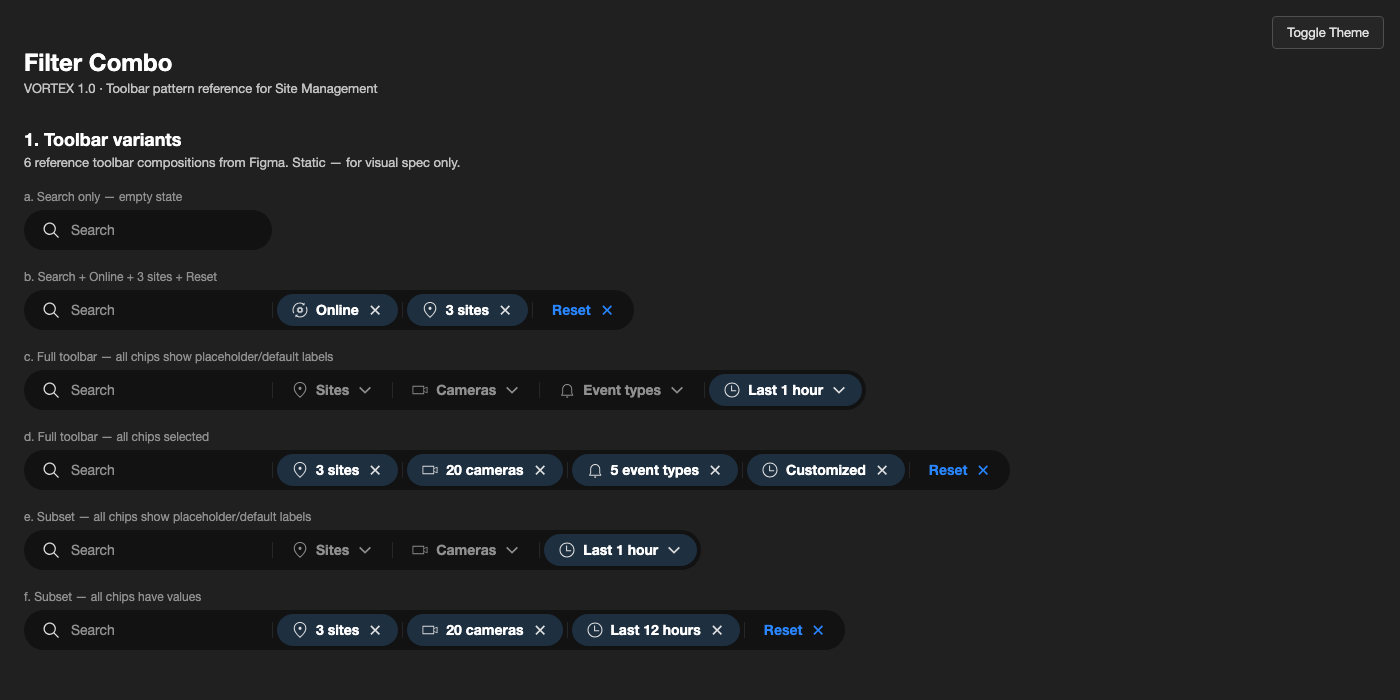
filter-combo/ · prototype.html
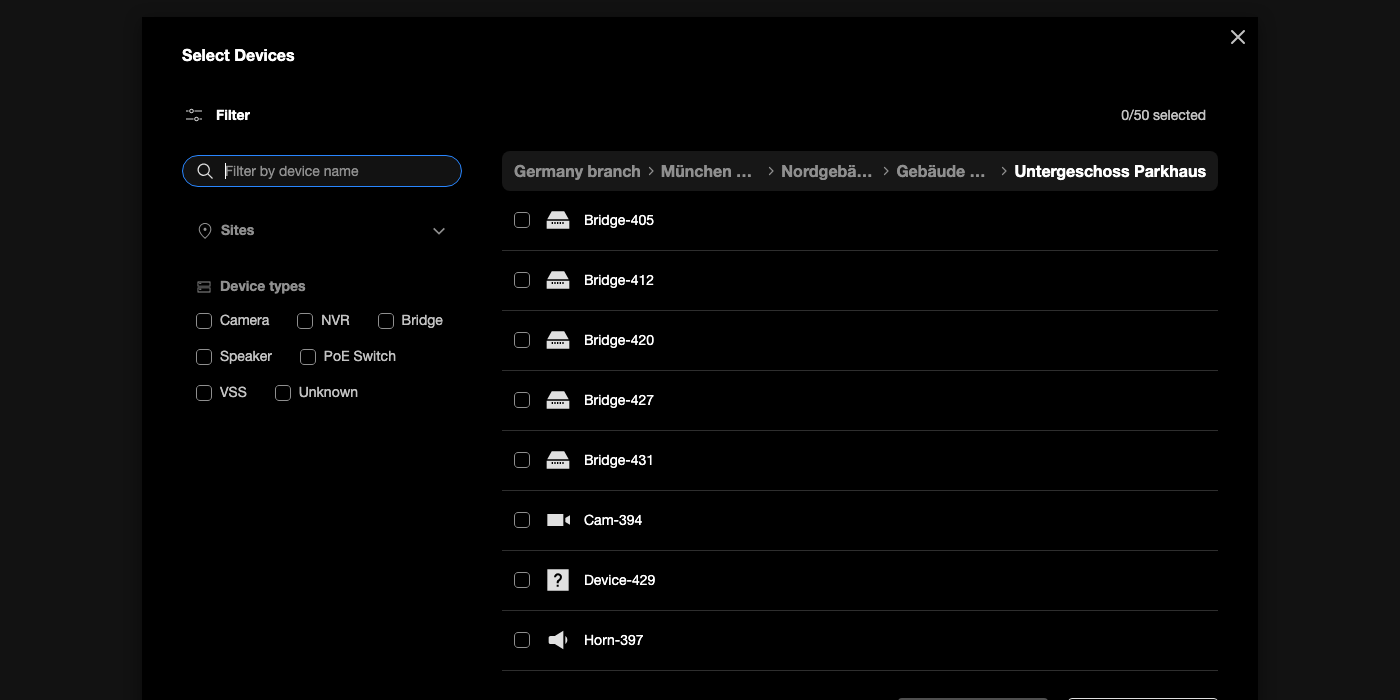
device-picker-dialog/ · prototype.html
PART 02
Team
Workflow
Most stages pair a technique with the artifact it produces.
The Flow
From intent to implementation.
01
Clarify intent
Humans align on the problem
→
02
Write the spec
Finalize + PR / review
→
03
Break down
API + UX spec, discuss
→
04
Build
Per endpoint, implement
→
05
Fix in production
Fix issues after go-live
04 fans out to
Backend
Web
iOS
Android
Team Workflow · Stage 01
Clarify intent
PO · PM · RD · UX · Architect·no AI
HumanPO presents the problem & contextframing
→
HumanTeam discusses to understand itfacilitation
→
HumanAgree scope: in / outscoping
→
OutputClarified intentagreed scope
project bglore
misc knowledge
constraints
AI Fluency
08
DelegationDescriptionDiscernmentDiligence
In practice · Stage 01
Clarify intent
Site Management · in developmentused brainstorming · probing the PM — FE · BE · UX, no agent yet
PMasks
“Build a Site module.” A feature request handed to the team — a solution, not yet a problem.
FE · BE · UXprobe
Pushed back on the PM — what are we actually trying to solve?don't build the feature as stated; find the problem behind it
FE · BE · UXbrainstorm
With the real problem clear, brainstormed the direction together across front end, back end, and UX.
Teamagree
Aligned on the problem and a rough scope — what's in, what's out (incl. breaking removals).
Outputclarified intent
The team owns the problem, not just the ticket. No agent has touched it yet — this is the human gate.
The real problem · dug out by probing
P1 Devices aren't tied to a physical site
P2 Management complexity grows with device count
P3 No inventory basis when expanding / replacing
P4 Monitoring vs. management roles blur at scale
P5 No site-level base for future features
Agreed scope · in / out
IN unified Site module · site-first workflow
multi-level Site › Subsite · single assignment
OUT · breaking View: Edit site
Device: Create site, Add device
Team Workflow · Stage 02
Write the spec
PM · RD+coding agent
HumanHand off the refined intenthandoff
→
AgentFormalize into openspecopenspec workflow
→
AgentDraft proposal · design · specsextract-behavior
→
HumanValidate & PR reviewspec review
→
OutputHigh-level specproposal.md · design.md · specs/
clarified intent
conventionsproject bg
architecturethe codebase
conventions
AI Fluency
10
DelegationDescriptionDiscernmentDiligence
In practice · Stage 02
Write the spec
Site Management · in developmentused openspec workflow · adversarial review — the whole team shaped it with the agent, then hunted for gaps
PMinput
A high-level request, not a spec — a Confluence page.“Site / Subsite — High Level Spec for AI-coding” v0.9
Team ⇆ Agentshape together
PM · RD · UX · Architect shape it into openspec format together with the agent — proposal + capabilities + scenarios, gated by openspec validate.
Agentadversarial
Ran an adversarial review — the reviewer must find issues, “looks good” not allowed — hunting the spec for conflicts, missing constraints, undefined edge cases.
Team ⇆ Agentrevise ×5
Every gap became a real change to the specs, before any code:
+ error-handling + Google Maps
fix conflicts, add constraints
rename Subsite → Area
map: center-pin drag
device-move warning
Outputsource of truth
A validated openspec change — 8 capabilities, 2 breaking module changes. Code follows this, not the Confluence page.
proposal.md · ## Why
Currently, site management is fragmented across View and Device modules, leading to inconsistent experiences and duplicated functionality. A dedicated Site module will provide a single source of truth for organizational hierarchy…
specs/site-hierarchy/spec.md
### Requirement: Site hierarchy structure
The system SHALL support Site > Area (L1–L4) > Device.
#### Scenario: Prevent exceeding depth
WHEN user adds an Area under a Layer-4 Area
THEN system rejects — max depth reached
Team Workflow · Stage 03
Break down
RD · UX+coding agent
BaseHigh-level spec
RD · AgentDerive the API contractshape & validate / OpenAPI
UX · AgentDraft UX spec + HTML prototypereview the flow / headless UI
OutputContractsAPI spec · UX spec · HTML prototype
API design principlesexisting contracts
design referencescomponent library
AI Fluency
12
DelegationDescriptionDiscernmentDiligence
In practice · Stage 03
Break down (1)
Floor Plan · shippedused hadlc-breakdown (api-designer · openspec-prototype)
Base
The floor-plan high-level spec, from Stage 02.
RD ⇆ Agent · API contract
Derive the OpenAPI
floor-plan CRUD + device-position / FOV — the shape both ends build to
⇆
UX ⇆ Agent · prototype + UX
Build the clickable prototype
the screens as something you can click — the tree and the canvas
built in parallel — the prototype surfaces what the API needs; the contract shapes the prototype
↺
and it loops back up — half-way through, the contracts can reveal the high-level spec itself is wrong. Change the spec, then re-derive.
Output
API spec · UX spec · clickable prototype — reconciled and reviewable before a line of code.
API contract · NEW · OpenAPI · api-ssot
GET POST /sites/{siteId}/floor-plans
GET PATCH DELETE /floor-plans/{id}
POST /floor-plans/{id}/upload
GET POST /floor-plans/{id}/device-positions
the API spec that didn't exist before
UX spec · floor-plan screens
· Upload floor-plan image
· Place devices on the plan
· Set camera FOV & direction
· Folder overview (recursive thumbnails)
In practice · Stage 03
Break down (2)
Site Management · in developmentused web-prototype-builder-vue — the prototype kept moving, round after round against the Figma frames
BaseUX spec
The hard screens to prototype — the filter toolbar and the device picker.
UX ⇆ Agentbuild
Scaffolded the interactions — toolbar, filter menus, trigger pipeline, empty and lazy-load states.
UX ⇆ Agentalign to Figma
Round after round against the Figma frames; tokenized to the VORTEX 1.0 design system.
UX ⇆ Agentsync with shipped
Matched the prototype to the shipped behaviour, across all three toolbar variants.
Outputsigned off
20+ revisions before it matched — a working screen the team clicks and signs off, not a static mockup.
filter-combo/ · clickable prototype.html
device-picker-dialog/ · clickable prototype.html
Team Workflow · Stage 04
Build
RD+coding agent
AgentGenerate per-endpoint technical specopenspec
→
HumanReview the technical specapi-and-interface-review
→
AgentImplement with testsTDD
→
HumanCode reviewcode-reviewer
→
OutputWorking codetechnical spec · code + tests
API + UX specthe codebase
API + UX specconventions
the codebaseteststech stack
conventions
AI Fluency
15
DelegationDescriptionDiscernmentDiligence
In practice · Stage 04
Build (1)
Floor Plan · shippedused openspec proposal → apply · TDD · code-reviewer
Basefrom breakdown
The floor-plan API contract + UX spec, handed down from Stage 03.
Agentopenspec proposal
Ran /openspec:proposal — scaffolded the change: proposal.md · design.md · tasks.md.
RDreview the tech spec
Validated the design & tasks before any code — the gate that catches problems early.
Agentopenspec apply
Ran /openspec:apply — implemented the tasks, test-first, on each surface.
RDreview the code
Five-axis code review — correctness, readability, architecture, security, performance — before merge.
Outputshipped
Merged, live — on every surface. Spec → code, traceable.
the contract · OpenAPI · api-ssot
POST /sites/{siteId}/floor-plans
GET /floor-plans/{id}
PATCH DELETE /floor-plans/{id}
POST /floor-plans/{id}/upload
FloorPlan: id · siteId · name · imageUrl
the technical spec · openspec · floor-plan-management
### Requirement: Floor Plan CRUD
#### Scenario: Create new floor plan
#### Scenario: Invalid floor plan name (pattern)
#### Scenario: Delete floor plan
In practice · Stage 04
Build (2)
Floor Plan · shippedThe same OpenAPI contract — but each surface does a different job, all built test-first and reviewed before merge.
Backend
vortex-backend · Go
Owns the data & contract
floor-plan CRUD · device positions · FOV, persisted
floor_plan_controller.go
floor_plan_repository.go
Web
app-vsaas-portal · Vue 3
The editor
drag devices onto the plan, draw each camera's FOV on a canvas
FloorPlanCanvas.vue · renderers/
FloorPlanCanvas.test.js
iOS
ioscharmander · Swift
The viewer
fetch & render the plan, tap a camera marker → live view
FloorPlanManager.swift
FloorPlanManagerTest.swift
Android
AndroidCharmander · Kotlin
The viewer
plan + camera-marker overlay, search across floor plans
FloorPlanViewerScreen.kt · CameraMarkerOverlay.kt
FloorPlanViewerViewModelTest.kt
Team Workflow · Stage 05
Fix in production
RD+coding agent
AgentMonitor site & logsCI runner / monitor
QA · humanVerify & reproducemanual + regression
AgentTriage the issuelog / issue triage
HumanJudge & decide the fixinvestigation
OutputFix shippedvia the spec · post-mortem
logserror tracking
the specstest cases
AI Fluency
18
DelegationDescriptionDiscernmentDiligence
In practice · Stage 05
Fix in production (1)
Floor Plan · shippedused Redmine · systematic-debugging — trace the symptom back to the spec
Liveshipped
Floor Plan running in production on Portal, iOS and Android.
QAreproduced
Moved a device to another Site — the camera count diverged: Portal 2 · iOS 2 · Android 1.Redmine #59610
Teamdiagnose
Not a rendering bug on any one platform — the spec never defined what happens when a device moves to another Site.
Team ⇆ Agentfix the spec
Three symptom tickets closed Won't Fix — define the behavior in the spec, not three local patches, then re-walk the flow.
Outputone definition
One spec change — every platform reads the same rule. Fix the spec, not the symptom.
Redmine #59610 · tracker: Spec
[Spec][Floor Plan] Spec doesn't define
device “move to other sites” behaviour
move 1 of 2 cameras to another Site →
Portal 2 iOS 2 Android 1
one gap → three symptom tickets
#59495 Android — count differs Won't Fix
#59533 Android/iOS — Site count Won't Fix
#59727 Portal — camera wrong Won't Fix
patch each = 3 patches that drift again.
fix the spec = one source of truth.
In practice · Stage 05
Fix in production (2)
Floor Plan · shippedused Redmine · openspec — trace a cluster of bugs back to one component spec
Liveshipped
The Floor Plan left-hand navigation tree, running in production.
QAsymptoms
A run of tree tickets — search broken, wrong device counts, new sites not listed, hierarchy inconsistent.Redmine #59730 · #59725 · #59726 · #59627 …
Teamdiagnose
Not seven separate bugs — one broken tree component: clicking a node expanded instead of selecting; a fixed shallow depth when the data nests far deeper; every feature reinvented its own tree.
Team ⇆ Agentrespec & re-walk
Instead of seven patches — a new openspec change for a generic tree component, then back through breakdown and build from the top.
Outputone component
A shared tree-view component — floorplan consumes it now; device list and views are next. Fix the spec, not the symptom.
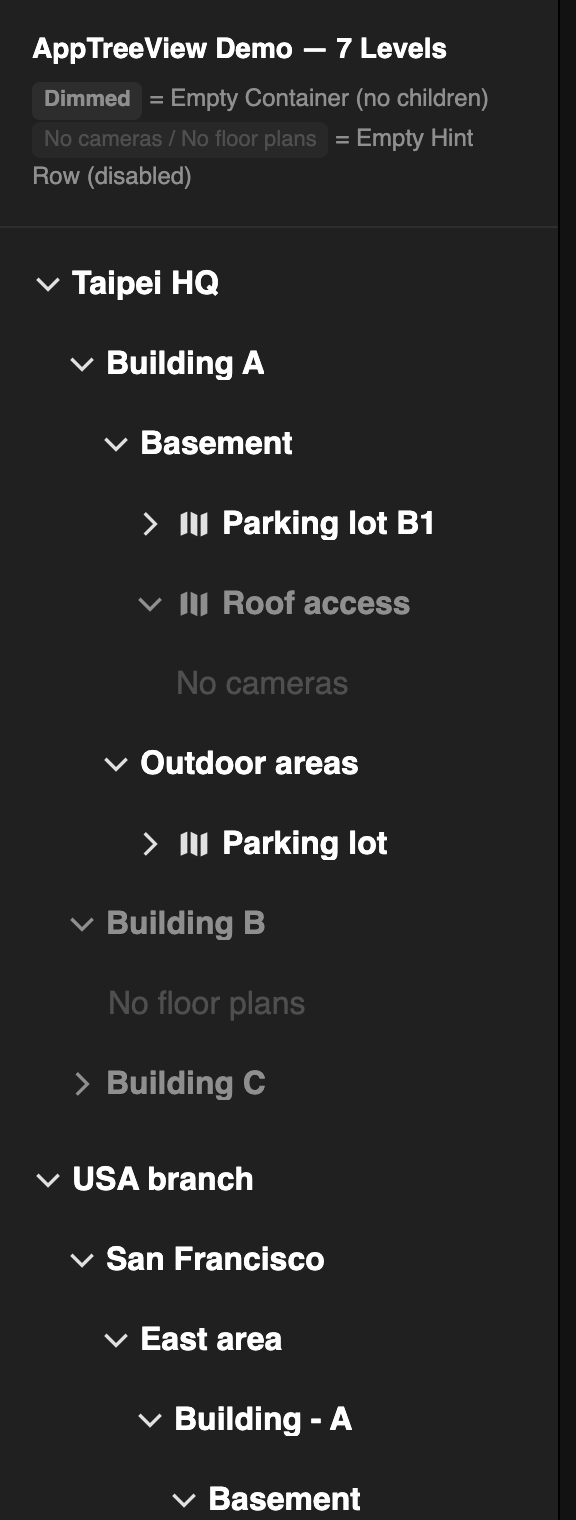
TreeView · the rebuilt component · 7 levels
the spec change · openspec · add-tree-view-component
NEW tree-view-component spec
click label = select, chevron = expand
behavior by node kind, not depth
search: auto-expand + highlight
up to 7 levels · mixed siblings
the code change · app-vsaas-portal
NEW components/TreeView/TreeView.vue
one component, node-kind driven
floorplan/…/FloorPlanTreeSidebar.vue
now consumes the shared TreeView
replaced the per-feature trees
In practice · Beyond the five stages
Beyond the flow (1)
Dev harness · shippedused superpowers:brainstorming · writing-skills — the skill that test-drives the skills it writes
BE devthe itch
“The front end has no throwaway URL to validate a branch against.” Not a feature — just friction.
FE ⇆ Agentbrainstorm
Used superpowers:brainstorming to design a per-branch preview harness — a design spec, not code first.
FE ⇆ Agentwriting-skills
Turned the design into a reusable skill — a /harness-deploy command + provisioning scripts the whole team runs.
Agentself-verify
writing-skills is TDD for skills — it pressure-tests the new skill with subagents, confirms it triggers and complies, and closes the loopholes before anyone relies on it.
UATspec amended
The target app rejected manual deploys (git-connected Amplify) — retargeted mid-build to oblivionis-preview. The spec moved, like any other.
Outputa new skill
pnpm harness:deploy <slug> → a per-branch HTTPS preview URL. The team taught the harness a new trick.
the design · superpowers:brainstorming
specs/2026-04-21-portal-harness-preview-design.md
pnpm harness:deploy <slug> → per-branch HTTPS URL
pnpm harness:destroy <slug> → clean up
guard rails: only harness- slugs, never protected branches
the skill · writing-skills
/harness-deploy /harness-destroy
scripts/provision-harness.sh
scripts/deploy-harness.sh · destroy-harness.sh
agent contract: ::preview-url::<url>
pressure-tested with subagents before ship
In practice · Beyond the five stages
Beyond the flow (2)
extract-behavior · in the skill libraryused writing-skills — capture the method once, every agent runs the same rigor
Patternnoticed
Every brownfield domain hits the same wall — “the code is the spec” — and someone re-derives it by hand each time.
RD ⇆ Agentdesign the method
Rather than repeat the work, designed one repeatable method: scope → discover → draft → audit → review → register.
RD ⇆ Agentthe hard part
Baked in a leak audit so specs stay behavioural, not code — MQTT → “streaming”, S3 → “the system stores”, JWT → “token”.
RD ⇆ Agentcapture as a skill
Wrote it up as extract-behavior — the method + OpenSpec format — so any agent runs the same rigor, not just its author.
Outputreusable
A team skill — applied since to Permission (4 scattered sources → one spec) and every new brownfield domain.
the design · extract-behavior/SKILL.md
workflow scope → discover → draft → audit → review
rule one capability = one spec.md
discover parallel backend + frontend agents
audit strip impl detail — keep behaviour
proof · applied to Permission
4 sources: Excel · Casbin · Vue · iOS
→ openspec/specs/permission/spec.md
source: extracted+authored
one skill → every brownfield domain after
PART 03
Roles
in the Loop
How each role works now — and stays in the loop with the others.
In the Loop · Role 01
RD — owns the spec, delegates the build.
Before, RD’s job ended at merge — now it never really does.
RD
Research & Development
The shift — RD moved up a loop
Outer loopCI/CD, deploy & ops · days–weeks
Middle loop RD nowSupervise agents — decompose work, calibrate trust, catch plausible-but-wrong output, keep architecture coherent · hours–days
Inner loopWrite, test, debug · minutes–hours
Inner / middle / outer loops · ThoughtWorks — Future of Software Engineering
Skills RD drives
brainstorming
openspec
api-and-interface-review
TDD
code-reviewer
harness-deploy
dogfood
smoke-test
Collaboration loops — not hand-off-and-forget
⇆Agent
Delegate the build; review the technical spec and the diff — the agent proposes, RD stays accountable.
⇆PM
Co-shape the high-level spec — feasibility, cost, and risk flow back before scope locks.
⇆UX
Build to the UX spec and prototype; the prototype ⇆ API loop keeps design and contract in sync.
⇆QA
Ship with tests already written; triage production issues together, then patch the spec.
In the Loop · Role 02
PM — owns intent, keeps the spec alive.
Before, PM wrote a doc and moved on — now the spec is a living contract.
PM
Product
The shift
- Own the high-level spec — the WHAT, not the HOW.
- Turn vague ideas into an agreed, testable spec.
- Keep the spec true as reality changes.
Skills PM drives
brainstorming
openspec
adversarial-review
Collaboration loops — not hand-off-and-forget
⇆Agent
Refine intent into a structured spec with the agent; validate every draft, then iterate.
⇆RD
Hand over intent and scope; get feasibility, cost, and risk back before committing.
⇆UX
Align on user flows early — the UX spec grows from shared intent.
⇆QA
Write acceptance criteria into the spec so QA can verify against it.
In the Loop · Role 03
QA — verifies against the spec, from day one.
Before, QA arrived at the end — now QA is in from the spec.
QA
Quality Assurance
The shift
- Verify against the spec — not ad-hoc clicking.
- Write test cases from the spec, early.
- Watch production with the agent; loop bugs back to the spec.
Skills QA drives
brainstorming
generate-test-cases
smoke-test
Collaboration loops — not hand-off-and-forget
⇆Agent
The agent monitors site and logs; QA verifies and reproduces — findings converge to triage.
⇆PM
Turn acceptance criteria in the spec into concrete, verifiable cases.
⇆RD
Tests are written before hand-off; triage production issues together.
⇆UX
Verify the build against the UX spec and prototype — not a screenshot.
In the Loop · Role 04
UX — ships a spec others can build and verify.
Before, UX threw a mockup over the wall — now the prototype is a living contract.
UX
Experience Design
The shift
- Write the UX spec and build an HTML prototype.
- Iterate on headless components — prototype ⇆ API.
- Hand off a spec QA can verify against.
Skills UX drives
brainstorming
openspec
prototype
generate-flow-spec
Collaboration loops — not hand-off-and-forget
⇆Agent
Draft the UX spec and generate the prototype with the agent on our headless components.
⇆PM
Translate intent into flows — the UX spec grows from the high-level spec.
⇆RD
The prototype ⇆ API loop keeps design and contract honest as both evolve.
⇆QA
Deliver a verifiable UX spec into
references/ so QA can check against it.PART 04
Context
& Harness
What we feed the agents — and the loop we're automating.
Context Engineering
Engineering the agent's context.
Fill the agent's window with the right information — durable knowledge it always needs, plus what's pulled in just-in-time as it works.
Durable knowledge
Project backgroundWhat & why
Tech stackLanguages, frameworks, infra
Conventions & principlesStyle, patterns, architectural rules
Architecture & decisionsBoundaries, ADRs, the why
Constraints & NFRsPerformance, security, compliance
Specs & contractsbehavioral · API spec · technical ↳ slides 3–5
LoreHistory, domain terms, tribal knowledge
Misc knowledgeGotchas, edge cases, references
Pulled in at runtime
The codebaseFiles by path / grep
Tools & integrationsMCP · Jira · Redmine · CI
TestsExpected behavior
MemoryCross-session state
ExamplesFew-shot, reference implementations
Agent skillsReusable procedures the agent invokes
In progress
What We're Building
Closing the loop, end to end.
Detect — the loop runs itself
01
CI runner
Triggers the loop on every change
→
02
Agent
Picks up and does the work
→
03
Monitor
Watches the live site & logs
→
04
Generate issues
Files what it finds for triage
Resolve — a human decides every change
05
Monitor issues
Jira · Redmine · GitHub
→
06
Triage
Cluster, dedupe, prioritize
→
07
Propose change
Agent drafts the fix
spec changecode changewontfix
→
08
Review
Human approves before it lands
Working With Agents
Mindset: AI Fluency
These run underneath every stage above — the human skills of Anthropic’s AI Fluency framework, in our own words.
01
Delegation
Decide what to hand the agent — and what stays human.
In our practiceHumans own intent and the spec; agents draft, derive, and implement.
02
Description
Say what you want clearly enough to build from.
In our practiceThe spec is the description — high-level intent, API contract, UX spec.
03
Discernment
Judge the output, the process, and the behavior.
In our practiceCode review, api-and-interface review, and human validation gates.
04
Diligence
Stay accountable — verify, trace, own the result.
In our practiceTests, spec provenance, and fixing the spec — not the symptom.
The Work
What we keep investing in.
01Build an agent-first environment and process.
02Design the context we feed the agents.
03Design the harness — the loop that runs the work.
04Keep fixing what blocks the flow — the harness of the harness.
05Judge and deliver with the AI Fluency 4D framework.
Questions & discussion